Getting started: check an article with Leanify
Leanify reads a mathematical article in LaTeX, compiles every sentence it can
read to Lean, and asks Lean to check what the article says. The article stays an
ordinary .tex file that you typeset and submit as before.
This guide follows one short note from a first draft to a certificate. The
draft, examples/Demo/draft.tex, contains four
mistakes of the kind that reach referees: a typo in a proof, a statement written
loosely, a definition that does not make sense everywhere it claims to, and a
theorem that is false as stated. Each is caught at a different step. The
finished note is examples/Demo/article.tex.
What a certificate guarantees
When lake build accepts the certificate of an article,
- every symbol is defined in the article before it is used, and every compiled
sentence has exactly one reading, which you can read (
--claims, the web reader), - the Lean statements are the readings of the very text in
article.tex(its contents are pinned by a hash), - every definition is well defined: no division by zero, no argument outside its domain,
- every verified claim is proved in Lean, using only the standard axioms,
- every claim the text derives (a proof step, or a result whose proof compiled) is proved from exactly what it rests on: the results it cites and the earlier steps of its proof, plus general mathematics from mathlib.
It does not check sentences the grammar does not read. Those are prose and are reported: a sentence of a theorem without a reading is a warning, because that part of the statement is not checked. Words the article does not define (a probability measure, the Lebesgue measure) mean what the vocabulary says (Vocabularies and models). The readings themselves are fixed by the grammar, so read them once to make sure they say what you mean.
1. Set up a project
Install Lean with elan. Then create a folder for the project with two files.
lean-toolchain:
lakefile.toml:
name = "mynote"

[[require]]
name = "leanify"
git = "https://github.com/Corrram/leanify.git"
rev = "main"   # or a commit, for a reproducible build
Then fetch Leanify and mathlib, with mathlib's compiled files:
The first lake exe leanify builds the checker (a few minutes, once).
2. Write the article
Put the article in a folder named after it, here Note/article.tex. The folder
name becomes the Lean namespace. Load the usual packages and leanify.sty
(copy it from .lake/packages/leanify/tex/ next to the article):
Write as you always do, in the style of Writing for Leanify:
define every symbol before you use it, with \coloneqq, give every quantifier,
and cite what a proof step uses. The note opens with an introduction, explains
each step between the results, and closes with a section on the classical
inequalities between means and a list of references. Those passages are prose,
and Leanify leaves them as they are. Here are the two sections with the
mathematics, between the first line of the introduction and the heading of the
last section (copy examples/Demo/draft.tex to Note/article.tex to follow
along):
\section{Introduction}\label{sec:intro}

How short can the perimeter of a rectangle of area one be?
% … the question, the result and the plan of the note, in words

\section{An identity}\label{sec:identity}

We study the sum of a positive number and its reciprocal as a function of the number.
Define $f:\mathbb{R}\to\mathbb{R}$ by $f(x)\coloneqq x+\frac1x$.
The domain matters: the reciprocal is not defined at zero, and negative numbers behave differently, as Section~\ref{sec:means} explains.

To compare the sum with two, we bring their difference to a common denominator, where a perfect square appears in the numerator.

\begin{lemma}\label{lem:identity}
For every $x\in(0,\infty)$, $f(x)-2=\frac{(x-1)^2}{x}$.
\end{lemma}

\begin{proof}
Let $x\in(0,\infty)$.
Then $f(x)-2=x+\frac1x-2=\frac{x^2-2x+1}{x}=\frac{(x-1)^2}{x}$.
\end{proof}

The identity turns the bound into a question about the sign of a quotient.

\section{The bound and its minimum}\label{sec:bound}

A square is never negative, and dividing it by a positive number keeps it so.
Together with Lemma~\ref{lem:identity}, this proves the bound.

\begin{theorem}\label{thm:bound}
For every $x\in(0,\infty)$, $f(x)>2$.
\end{theorem}

\begin{proof}
Let $x\in(0,\infty)$.
Then $\frac{(x-1)^2}{x}\ge0$.
By Lemma~\ref{lem:identity}, $g(x)-2=\frac{(x-1)^2}{x}\ge0$.
\end{proof}

The bound cannot be improved, because the number one attains it.
Its reciprocal is itself, so the sum there is exactly two, and the theorem shows that no other number does better.

\begin{corollary}\label{cor:min}
The function $f$ attains its minimum on $(0,\infty)$ at $1$.
\end{corollary}

\begin{proof}
By Theorem~\ref{thm:bound}, $f(1)=2\le f(x)$ for every $x\in(0,\infty)$.
\end{proof}

In the language of the introduction, among all rectangles of area one the square has the least perimeter.

\section{Arithmetic and geometric means}\label{sec:means}
% … the result among the inequalities between means, with references
3. Check while you write
The check runs in about a second and certifies nothing. It reads the article the way the kernel will:
Note/article.tex:70:1: warning: sentence not compiled (undefined symbol: g); it asserts nothing checked
Note/article.tex:77:1: warning: corollary sentence without a mathematical reading: The function $f$ attains its minimum on $(0,\infty)$ at $1$.
Note/article.tex: 1 definitions, 5 claims
  text: 1 compiled, 0 failed, 40 prose (of 41)
  results: 2 compiled, 0 failed, 1 prose (of 3)
  proofs: 5 compiled, 1 failed, 0 prose (of 6)
  all: 8 compiled, 1 failed, 41 prose (of 50)
The 40 prose sentences of the text are the explanations: the abstract, the introduction, the remarks between the results, the last section and the references. The check counts them and says nothing else about them, because they assert nothing that Lean is asked to check. A sentence of the running text that does have a reading, such as a definition, is compiled like any other. Only a sentence inside a result without a reading is a warning, since it leaves part of the statement unchecked.
- Line 70 uses
g, which nothing defines. It is a typo forf. - Line 77 is the whole statement of the corollary, and the grammar has no
reading of "attains its minimum on … at …". Unread, the corollary would assert
nothing checked. Say it as an inequality:
For every $x\in(0,\infty)$, $f(1)\le f(x)$.
With both fixed, --claims prints the reading of every claim. These readings
are what Lean will prove, so read them:
lake exe leanify check Note/article.tex --claims
Note/article.tex:42:1: info: defines f (f)
Note/article.tex:48:1: info: claim 0: \forall x\in \mathbb{R},\ 0<x\Rightarrow f(x)-2=\frac{{(x-1)}^{2}}{x}
Note/article.tex:53:1: info: claim 1: \forall x\in \mathbb{R},\ 0<x\Rightarrow f(x)-2=x+\frac{1}{x}-2\land x+\frac{1}{x}-2=\frac{{x}^{2}-2\,x+1}{x}\land \frac{{x}^{2}-2\,x+1}{x}=\frac{{(x-1)}^{2}}{x}
Note/article.tex:64:1: info: claim 2: \forall x\in \mathbb{R},\ 0<x\Rightarrow 2<f(x)
Note/article.tex:69:1: info: claim 3: \forall x\in \mathbb{R},\ 0<x\Rightarrow 0\le \frac{{(x-1)}^{2}}{x}
Note/article.tex:70:1: info: claim 4: \forall x\in \mathbb{R},\ 0<x\Rightarrow f(x)-2=\frac{{(x-1)}^{2}}{x}\land 0\le \frac{{(x-1)}^{2}}{x}
Note/article.tex:77:1: info: claim 5: \forall x\in \mathbb{R},\ 0<x\Rightarrow f(1)\le f(x)
Note/article.tex:81:1: info: claim 6: \forall x\in \mathbb{R},\ 0<x\Rightarrow f(1)=2\land 2\le f(x)
Every sentence of the results and proofs now has a reading. --prose also
lists the proof sentences the grammar does not read, and
editors/vscode/tasks.json shows all findings as squiggles in the .tex file.
4. Generate the Lean files
wrote Note/Compiled.lean
wrote Note/Article.lean
wrote Note/Proofs.lean
wrote Note/Certified.lean

1 definitions and 7 claims.
Add the library to lakefile.toml (once):

[[lean_lib]]
name = "Note"
srcDir = "."
globs = ["Note.+"]

then build the certificate with `lake build Note.Certified`.
The four files never need to be rewritten by hand except Proofs.lean:
| File | What it does |
|---|---|
Compiled.lean |
The kernel compiles article.tex, pinned by the hash of its contents. |
Article.lean |
Every definition and claim as ordinary Lean: f, claimK, meaningfulK (every term of claim K is defined) and obligationK (its premises imply it). |
Proofs.lean |
Your proofs. init writes a stub for each. |
Certified.lean |
The certificate. It also writes article.leanify.json and article.leanify.tex. |
Each stub states the claim, where it comes from and what it rests on:
/-- Claim 2, statement (theorem at line 64; premises: claim 3, claim 4, claim 0):
`\forall x\in \mathbb{R},\ 0<x\Rightarrow 2<f(x)` -/
theorem proof2 : obligation2 := by
  intro_premises
  refine ⟨by unfold meaningful2; definedness [], ?_⟩
  sorry
The theorem rests on the two steps of its proof (claims 3 and 4) and on the
lemma that the second step cites (claim 0). intro_premises makes them
hypotheses c3, c4 and c0.
5. Build: the definitions must make sense
Line 23 is the well-definedness of f. The draft defines f on all of
\mathbb{R}, so \frac1x has to make sense for every real x, including
x = 0, and Lean is asked to derive a contradiction from x = 0, which it
cannot. The article only ever uses f on positive numbers, so the definition
should say so:
After every edit of the article, update its pin and build again:
info: Note/Certified.lean:12:0: claim 0 is not verified: its proof Note.Proofs.proof0 uses sorry
…
info: Note/Certified.lean:12:0: 7 claims: 0 derived in the text from their citations, 0 justified by companion proofs, 0 refuted, 7 unverified; 1 definitions well defined. Axioms: [propext, Classical.choice, Quot.sound]
The certificate is built, and it covers the definition only: a proof that
still uses sorry leaves its claim unverified. You can certify an article
while its proofs are being written.
6. Prove the claims
Replace each sorry by a proof. Most proof steps are routine, and
scripts/leanify_prove.py proves those with standard tactics, and the rest with
a model if you give it one
(leanify_prove.py):
An obligation it cannot prove, such as the false theorem's below, keeps its
sorry. Here is how the proofs look by hand. A proof step follows from what it rests on:
theorem proof4 : obligation4 := by
  intro_premises
  exact ⟨by unfold meaningful4; definedness [], fun x hx => ⟨c0 x hx, c3 x hx⟩⟩
#leanify_certify audits every claim the text derives: its proof may use its
premises, mathlib and the article, but no other result of yours. A proof step
that needs a lemma the sentence does not cite is rejected, so cite it in the
text.
The theorem resists:
theorem proof2 : obligation2 := by
  intro_premises
  refine ⟨by unfold meaningful2; definedness [], fun x hx => ?_⟩
  obtain ⟨h, h'⟩ := c4 x hx
  linarith
error: Note/Proofs.lean:49:2: linarith failed to find a contradiction
…
h : f x - 2 = (x - 1) ^ 2 / x
h' : 0 ≤ (x - 1) ^ 2 / x
a✝ : f x ≤ 2
⊢ False
The proof gives f(x) - 2 ≥ 0, and the theorem claims f(x) > 2. At x = 1
the two sides are equal, so the theorem is false as stated. Record that in Lean:
theorem refute2 : meaningful2 ∧ ¬ claim2 := by
  refine ⟨by unfold meaningful2; definedness [], fun h => ?_⟩
  have h1 := h 1 one_pos
  norm_num [f] at h1
info: Note/Certified.lean:12:0: claim 2 is false: Note.refuted2
info: Note/Certified.lean:12:0: claim 5 is not verified: it rests on claim 2, which is refuted
info: Note/Certified.lean:12:0: claim 6 is not verified: it rests on claim 2, which is refuted
info: Note/Certified.lean:12:0: 7 claims: 4 derived in the text from their citations, 0 justified by companion proofs, 1 refuted, 2 unverified; 1 definitions well defined. …
The corollary and its proof rest on the false theorem, so they are not verified either, even though their own proofs are correct. The diagnostics, the PDF and the web reader all show it:
python .lake/packages/leanify/scripts/leanify_diagnostics.py Note/article.leanify.json
Note/article.tex:64:1: error: statement (claim 2) is false as stated: refuted by Note.Proofs.refute2
Note/article.tex:77:1: warning: statement (claim 5) compiled but not verified: it rests on claim 2, which is refuted
Note/article.tex:81:1: warning: proof step (claim 6) compiled but not verified: it rests on claim 2, which is refuted
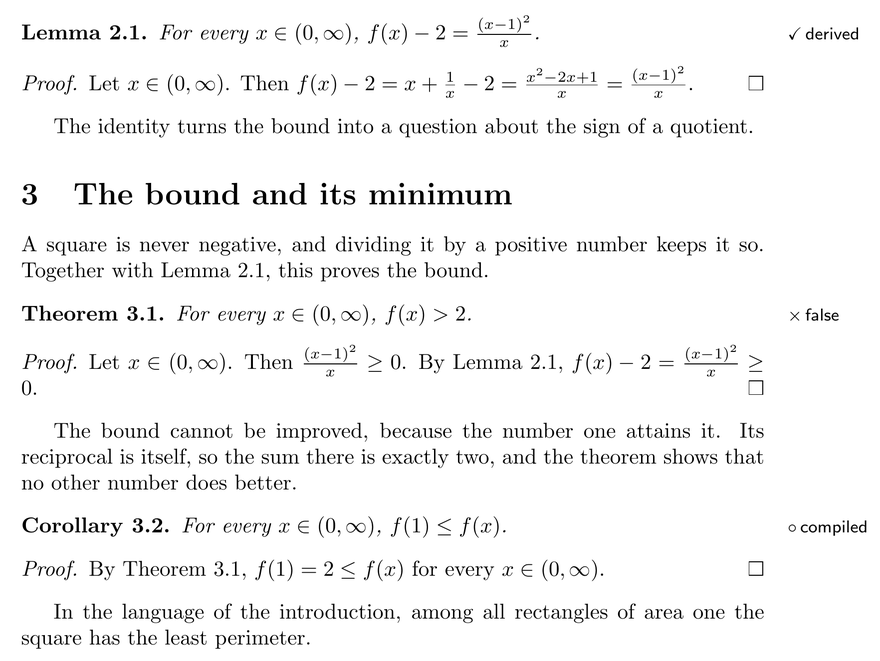
The live demo has the web reader of this draft and of the finished note.
7. Fix the statement
The theorem should say $f(x)\ge2$. After the edit, prepare and the
original proof of the theorem (with refute2 removed):
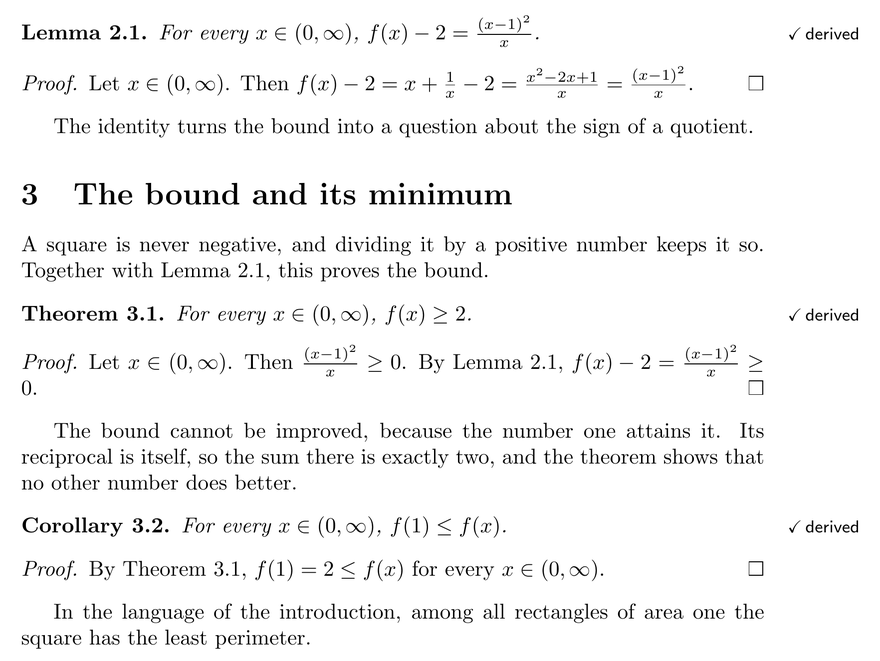
info: Note/Certified.lean:12:0: 7 claims: 7 derived in the text from their citations, 0 justified by companion proofs, 0 refuted, 0 unverified; 1 definitions well defined. Axioms: [propext, Classical.choice, Quot.sound]
Every claim of the note is now derived in the text: each sentence of every proof
follows from what it cites, and each result from its proof.
examples/Demo/Proofs.lean has all the proofs.
8. Read and share the result
- The PDF.
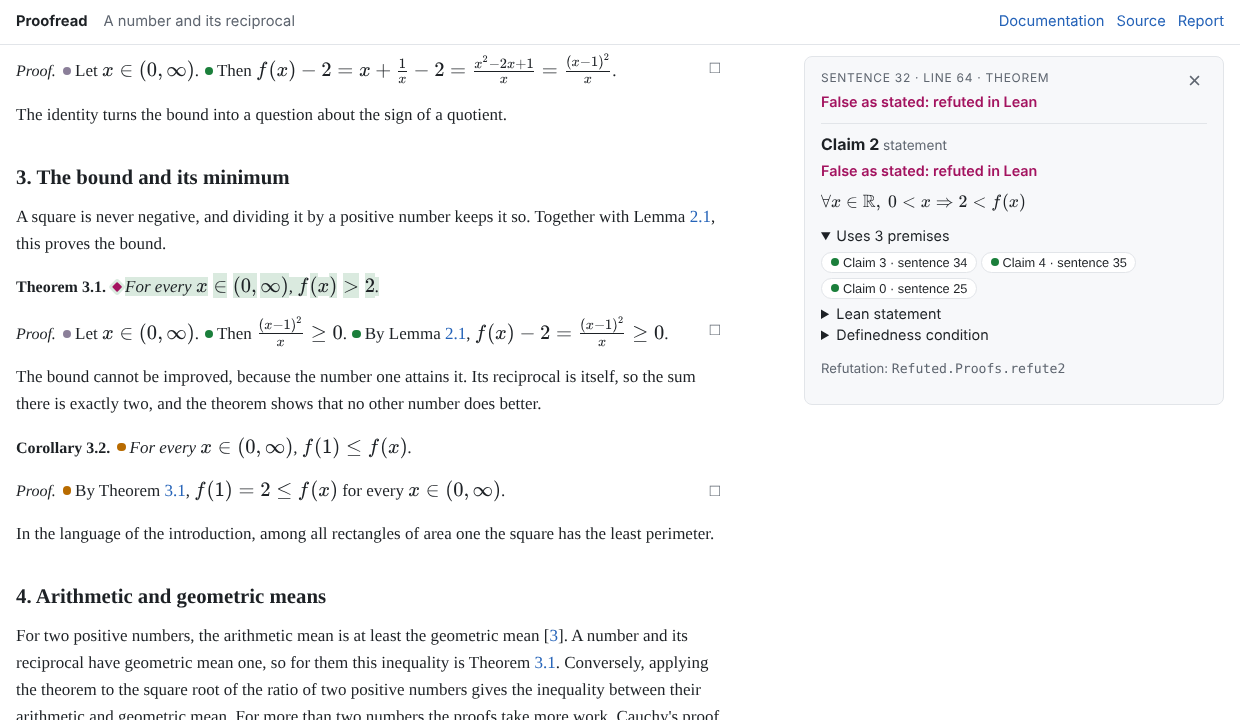
\usepackage[status]{leanify}puts the status of every labelled result in the margin (fromarticle.leanify.tex): derived, checked, partly checked, compiled, or false. Without the option the typeset article is unchanged, which is what you submit. Compiled with shell escape (pdflatex -shell-escape), the package also runs the quick check every time, and its findings appear as LaTeX warnings at their lines.\usepackage[certify]{leanify}runs steps 4 and 5 as well: it writes the Lean files the first time, then updates the pin and builds the certificate before it reads the marks (leanify.sty). - The web reader. It renders the article from its source with a marker at every sentence, and shows for each one its formal reading, Lean statement, premises and justification:
npm ci --prefix .lake/packages/leanify
node .lake/packages/leanify/reader/build.mjs Note/article.tex
This writes Note/article-reader/index.html.
- The diagnostics.
leanify_diagnostics.py … --verifiedexits with an error unless every compiled claim is verified, so it can gate CI.
9. Check in CI
name: Leanify
on: [push, pull_request]
jobs:
  certify:
    runs-on: ubuntu-latest
    steps:
      - uses: actions/checkout@v4
      - uses: leanprover/lean-action@v1
        with:
          build: 'false'
          use-mathlib-cache: 'true'
      - run: lake build Note.Certified
      - run: python .lake/packages/leanify/scripts/leanify_diagnostics.py Note/article.leanify.json --verified
The build fails if the article changed without prepare, if a definition is
not well defined, or if a proof breaks. The last step fails if a claim is not
verified or is refuted.
When something does not work
| You see | Do this |
|---|---|
sentence not compiled (undefined symbol: …) |
Define the symbol earlier, or fix the typo. |
… sentence without a mathematical reading |
Rephrase with a construction from Writing for Leanify. In a proof, prose is fine: it asserts nothing. |
the article changed after … or a stale pin |
lake exe leanify prepare article.tex --lean Compiled.lean, then build. |
unsolved goals in definedI or meaningfulK |
A term is not defined everywhere it is used. Restrict the domain, or give definedness [h₁, …] the facts it needs. It finds hypotheses, numeric side conditions and signs that positivity proves, but not facts about your definitions, such as A x y ≠ 0 for a mean A. |
claim K is derived in the text from its citations, but its justification … uses … |
The proof uses a result the sentence does not cite. Cite it in the text. |
linarith failed, or any proof that will not close |
Check the reading (--claims). If the claim is false, prove refuteK. |
For longer articles, prepare --cache splits the kernel's work by section
(From the .tex file to the certificate). Two research articles
compiled this way are listed on the home page.